It preserves standard writing.
Layer 0 is the ordinary spelling. A12 does not ask communities to abandon their orthography or write everyday text differently.
A12 Code
A12 is the BantuNomics layered orthography code and codec. It starts with the ordinary spelling a model sees, then adds the sound facts that ordinary spelling does not reliably mark: vowel length, tone, downstep, phrase boundary, and voice quality.
Plain definition
The Flat Text Problem exists because ordinary text collapses a spoken Bantu form into a one-dimensional string. A12 reverses that compression in a controlled way. It treats native audio as canonical evidence, aligns that evidence to the syllable, and writes the recoverable sound facts as additive layers.
The design principle is simple: do not destroy the original orthography. Preserve the standard spelling as the base layer, then add explicit layers for the acoustic facts a machine needs but the page does not show.
What A12 is and is not
Layer 0 is the ordinary spelling. A12 does not ask communities to abandon their orthography or write everyday text differently.
Layers above L0 expose vowel length, tone, downstep, boundary, and voice-quality evidence so models can reason over what native speakers hear.
A12 outputs should be traceable to audio, syllable alignment, confidence, and provenance. The point is not decoration; the point is verifiable structure.
Pipeline
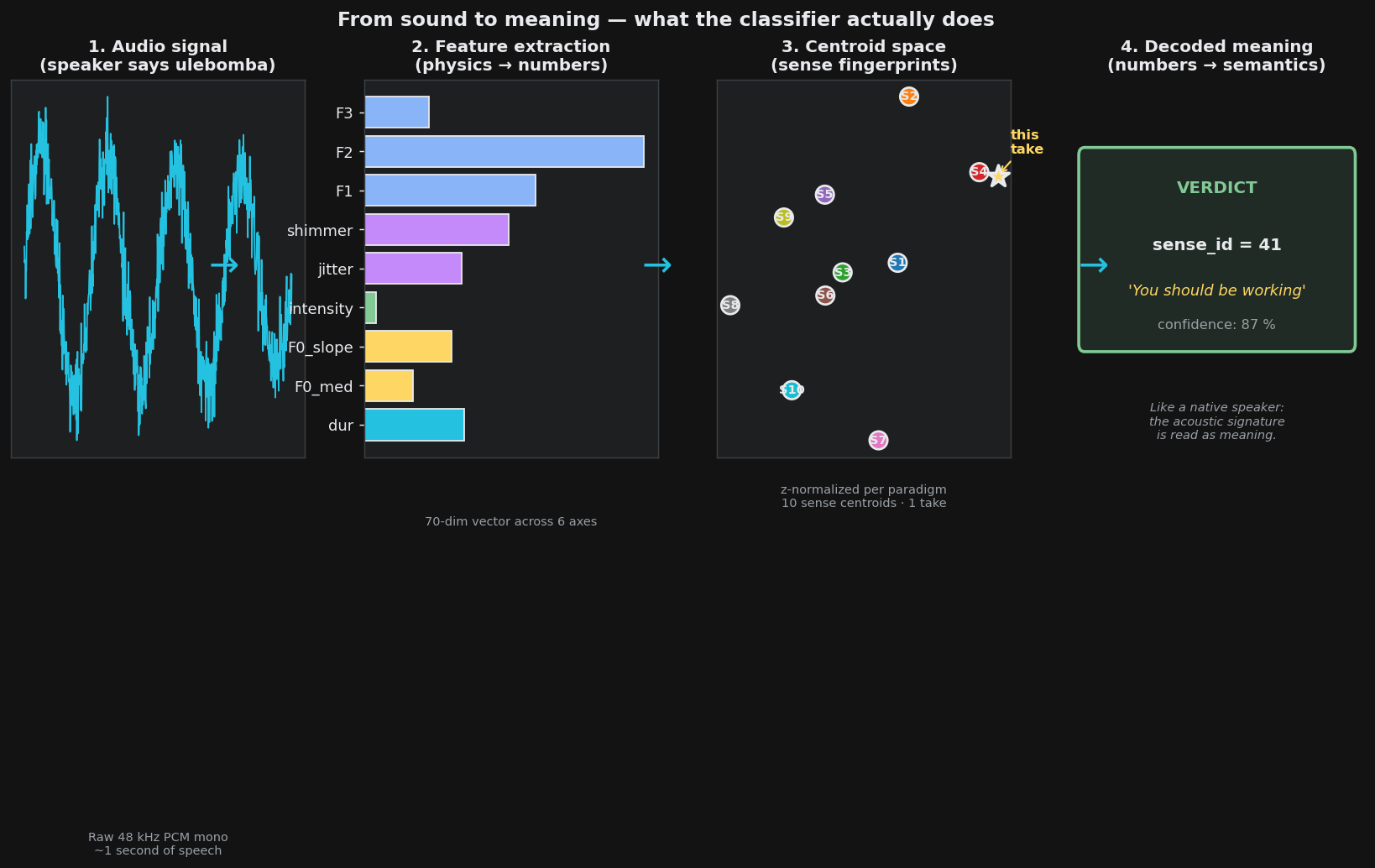
A consented native recording is paired with the ordinary spelling, for example ulebomba.
The word is parsed into syllables so the vowel nuclei, the tone-bearing positions, are addressable.
Length, F0 contour, downstep, boundary slope, and voice-quality evidence are measured from the signal.
A12 composes the evidence into additive orthographic layers without destroying the original spelling.
The resulting layer bundle can support ASR, TTS, MT, pedagogy, corpus annotation, and evaluation workflows.
Codec layers
The standard written form. It is useful for native readers, but it does not encode the full sound layer.
The codec reveals concealed vowel length where the audio shows a long nucleus that ordinary spelling does not mark.
Tone marks are attached to the vowel nucleus, because the syllable is the tone-bearing unit.
Downstep marks places where a high tone is realized lower than expected because of tonal structure.
The phrase edge separates statements, questions, and discourse boundaries that flat text does not expose.
Voice quality is a higher acoustic layer. It is not a replacement for tone; it is another channel in the signal.
uLebomba evidence
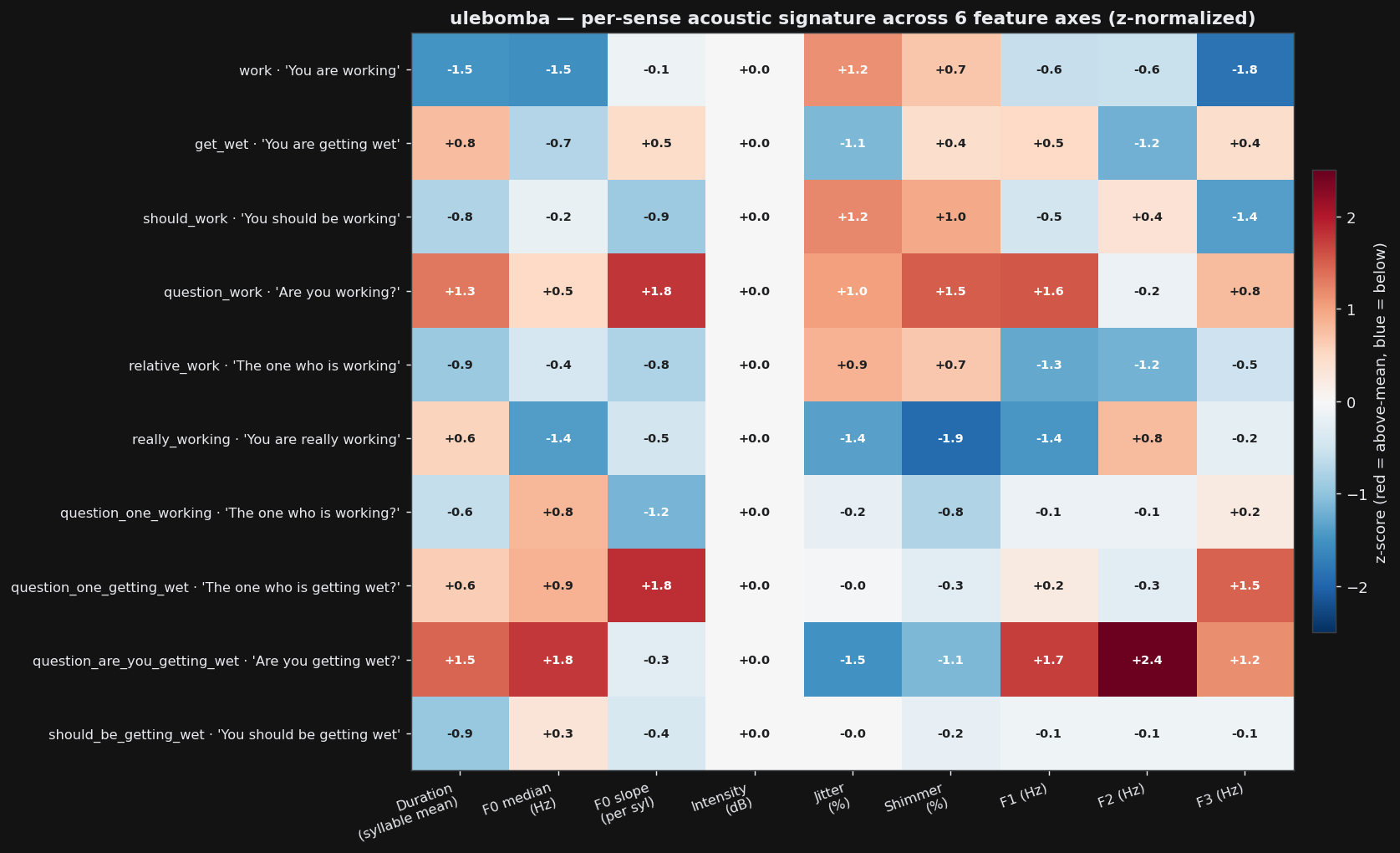
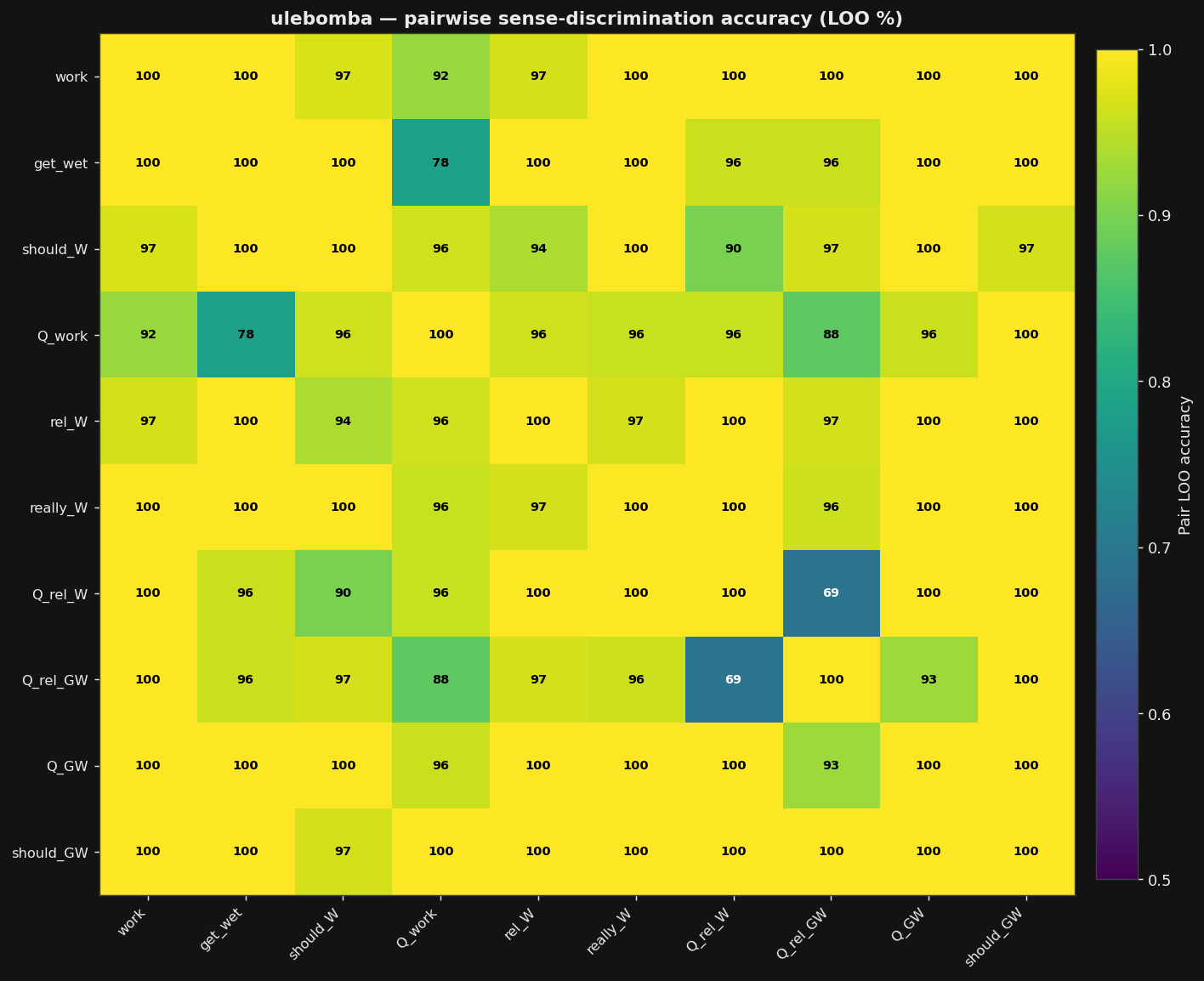
The same flat spelling can carry different meanings because the decisive evidence lives in the signal. These artifacts show how the A12 view separates the signal, the sense axis, and the pairwise differences that flat text collapses.
Enterprise use
For ASR, TTS, translation, pedagogy, corpus annotation, and model evaluation, the value of A12 is that the missing sound layer becomes addressable. A model no longer sees only one token. It sees the ordinary spelling plus the layered evidence needed to separate meaning.
Prove it free, validate it on your own data, or license the whole program.
Score your model against the foundational layer — the Alphabet Test and the L26 Lite suite, with saved results. Self-serve, no cost.
Three languages you choose — and everything we hold for them. Measured on your own held-out data.
Every product, every language, the full consented corpus — and everything curated while you're subscribed.